PRELIMINARY TECHNICAL OVERVIEW
Valdeira-1
Technical
manualEversteel Technologies
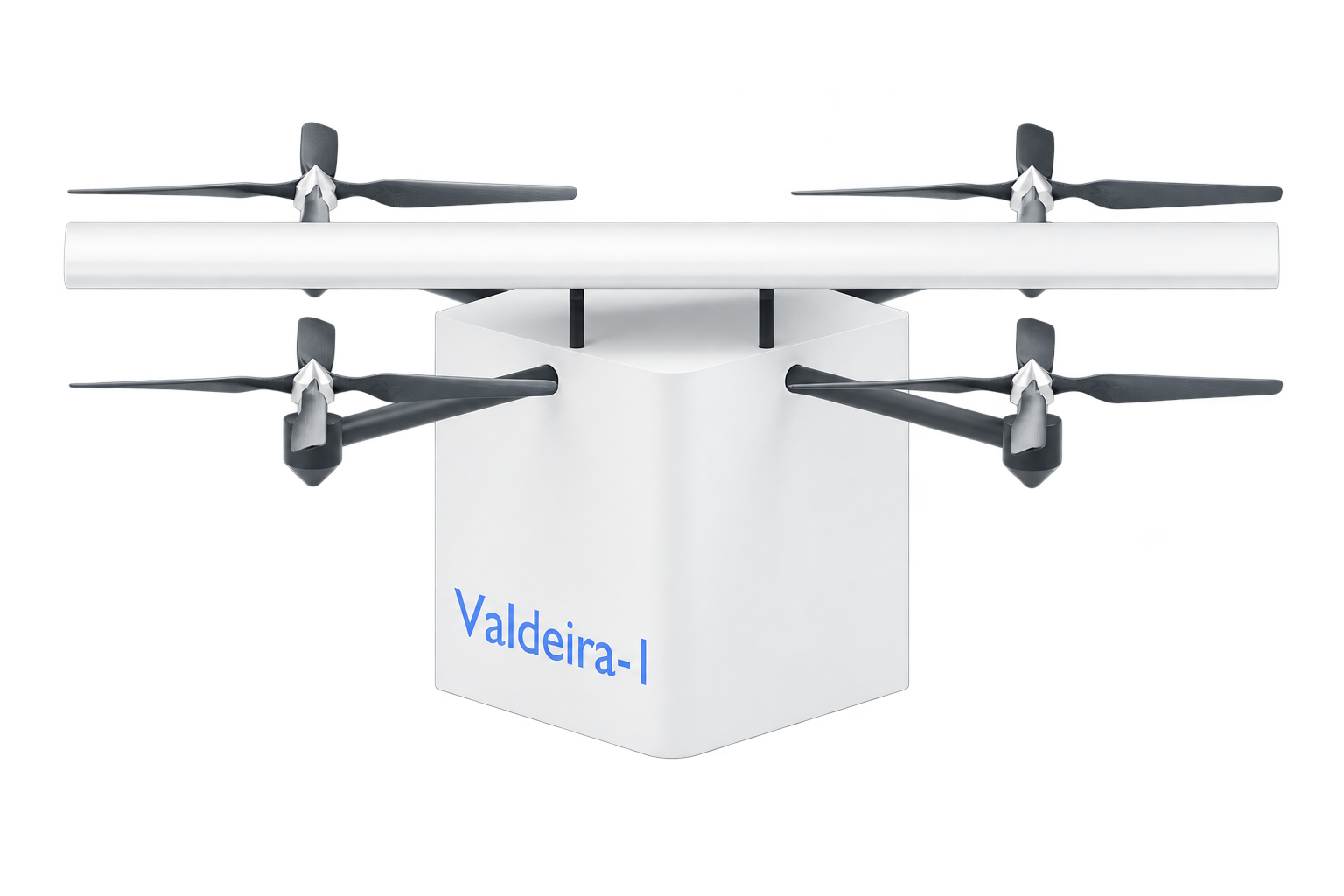
Mission profile, component specifications
and the current engineering design.
Preliminary design information. Values and status labels follow the supplied technical manual; targets, estimates and supplier-reported data are not validated flight-test results.
Mission profile
The reference mission is composed of three phases: payload delivery, payload drop-off, and return to the ground station. The actual range and flight speed values depend on the mass of the payload and weather conditions.
| PARAMETER | PRELIMINARY VALUE | CONDITIONS / BASIS | STATUS |
|---|---|---|---|
| Control method | Remote controller | Manual landing | Design intent |
| Cruise speed | 55 km/h | Horizontal speed, no-wind condition | Target |
| Cruise altitude | 50 m | Operating height above sea level | Target |
| Landing area | 3 m × 3 m concrete pad | Full footprint incl. propellers inside | Target |
| Control-link range | At least 2.5 km | Environment, margin and test method TBD | Target |
| Hover noise | ≤ 50 dB(A) at 5 m | Vertically below UAV; test protocol TBD | Target |
| Weather | Dry-weather operation only | Day/night and operating-area limits TBD | Design intent |
| Maximum payload | 5 kg | During first leg cruise | Target |
| Battery configuration | 12S 33Ah | Fully charged battery | Design intent |
| Mission distance target | 2 km | Dry weather only | Target |
| Max leg-time target | 10 min | During delivery and return | Target |
Technical specifications
Preliminary engineering specification
Structures
| PARAMETER | TARGET / DESIGN LIMIT | UNIT | STATUS |
|---|---|---|---|
| A · Vehicle structureTop-level constraints and structural layout. | |||
| Minimum payload envelope | 0.50 × 0.50 × 0.50 | m | TARGET |
| Frame footprint excluding propellers | ≤ 1.00 × 1.00 | m | TARGET |
| Overall footprint including propeller sweep / wing | ≤ 1.75 × 1.75 | m | TARGET |
| Overall vehicle height | ≤1.0 | m | TARGET |
| Structural assembly mass | 22 | kg | ESTIMATION |
| B · Cargo box and payload retentionGeometry, construction, attachment and protection of the 5 kg payload. | |||
| Cargo box dimensions | 0.50 x 0.50 x 0.50 | m | TARGET |
| Cargo box maximum empty mass | 2 | kg | ESTIMATION |
| Cargo box material / grade | Aluminium | — | TO SELECT |
| Wall thickness | 5 | mm | TBD |
| C · Arms and landing gearSpecify structural arms independently from propeller aerodynamic specifications. | |||
| Number of rotor-support arms | 4 | — | TARGET |
| Arm length | 485 | mm | ESTIMATION |
| Sweep angle | 0 | deg | TBD |
| Arm diameter | 45 | mm | TBD |
| Arm material / grade | CFRP | — | TO SELECT |
| Mass of one arm | 140 | g | ESTIMATION |
| Number of landing supports / contact points | 4 | — | TARGET |
| Landing gear material / grade | CFRP | — | TO SELECT |
| Landing gear total mass | [TBD] | kg | TO CALCULATE |
| Landing gear overall height | 700 | mm | TBD |
| D · Wing and aerodynamic load-bearing structureComplete only if the fixed-wing / hybrid concept is selected. Envelopes still apply. | |||
| Overall deployed wing span | 1.75 | m | TARGET |
| Wing planform area | 0.96 | m² | ESTIMATION |
| Aspect ratio | 3.19 | — | ESTIMATION |
| Taper ratio | 1 | — | ESTIMATION |
| Root chord | 0.55 | m | ESTIMATION |
| Sweep | 0 | deg | ESTIMATION |
| Root airfoil | NACA0012 | — | ESTIMATION |
| Tip airfoil | NACA0012 | — | ESTIMATION |
| Wing structural mass | 1.2 | kg | ESTIMATION |
Battery
The selected battery is the Tattu 330Wh/kg 33000mAh 12S1P 44.4V 10C (SKU: TARBG3333K12S10X), as it fulfils all the requirements set for the power subsystem, when it comes to discharge and charge rate. It is also optimized for the highest mass-specific energy capacity. The following table presents all the most important properties of the battery, taken from the manufacturer datasheet.
| Parameter | Value | Unit | Source |
|---|---|---|---|
| Energy capacity | 1465.2 | Wh | Manufacturer |
| Battery mass | 4.7 | kg | Manufacturer |
| Mass-specific energy capacity | 314 | Wh/kg | Manufacturer |
| Maximum constant discharge rate | 1.5 | C | Manufacturer |
| Peak discharge rate | 10 | C | Manufacturer |
| Gravimetric energy density | 1.188–1.260 | MJ/kg | Manufacturer |
| Nominal voltage | 44.4 | V | Manufacturer |
| Charge cutoff voltage | 50.4 | V | Manufacturer |
| Discharge cutoff voltage | 30.0 | V | Manufacturer |
| Discharge temperature range | -20~60 | °C | Manufacturer |
| Internal resistance | ≤15 | mΩ | Manufacturer |
| Dimensions | 212x91.5x117.2 | mm | Manufacturer |
Propulsion
| PARAMETER | TARGET / DESIGN LIMIT | UNIT | STATUS |
|---|---|---|---|
| A · REQUIRED PERFORMANCESpecified at maximum take-off mass (MTOM) unless another condition is noted. | |||
| Combined hover thrust at MTOM | ≥ 235.4 | N | CALCULATED TARGET |
| Required hover thrust per rotor | ≥ 58.9 | N | CALCULATED TARGET |
| Combined maximum static thrust | ≥ 565.1 | N | CALCULATED TARGET |
| Required maximum static thrust per rotor (two rotors only) | ≥ 141.4 | N | CALCULATED TARGET |
| Overall maximum thrust / weight ratio | 2.4 | — | TARGET |
| Hover rotor speed | 1800 | rpm | SUPPLIER-RATED |
| Rotor speed at maximum static thrust | 2800 | rpm | SUPPLIER-RATED |
| Maximum permitted continuous rotor speed | 2800 | rpm | TO BE VERIFIED |
| Hover shaft power per rotor | 511 | W | SUPPLIER-RATED |
| Maximum required shaft power per rotor | 2269 | W | SUPPLIER-RATED |
| Rotor acoustic contribution in hover at 5 m | <50 | dB(A) | Target |
| B · PROPELLER GEOMETRYDocument geometric dimensions for the propeller revision under evaluation. | |||
| Number of lifting rotors, N | 4 | — | CONFIGURATION |
| Propeller outer diameter | 711.2 | mm | SUPPLIER-RATED |
| Geometric pitch at 75% radius | 508 | mm | SUPPLIER-RATED |
| Pitch-to-diameter ratio (P/D) | 1.4 | — | SUPPLIER-RATED |
| Blades per propeller | 4 | — | SUPPLIER-RATED |
DOCUMENT NOTES
About this brief
This page follows the structure and technical tables of the supplied Quiet Cargo UAV Technical Manual. All figures retain the source document’s stated status. The downloadable PDF preserves the supplied manual’s formatting and content.
Some dimensions, component choices and performance figures remain preliminary. Supplier-reported values have not been independently verified here. Aircraft images depict the design model.
Download the technical manual PDF